Facebook
 X
 Pinterest
 Copy Link
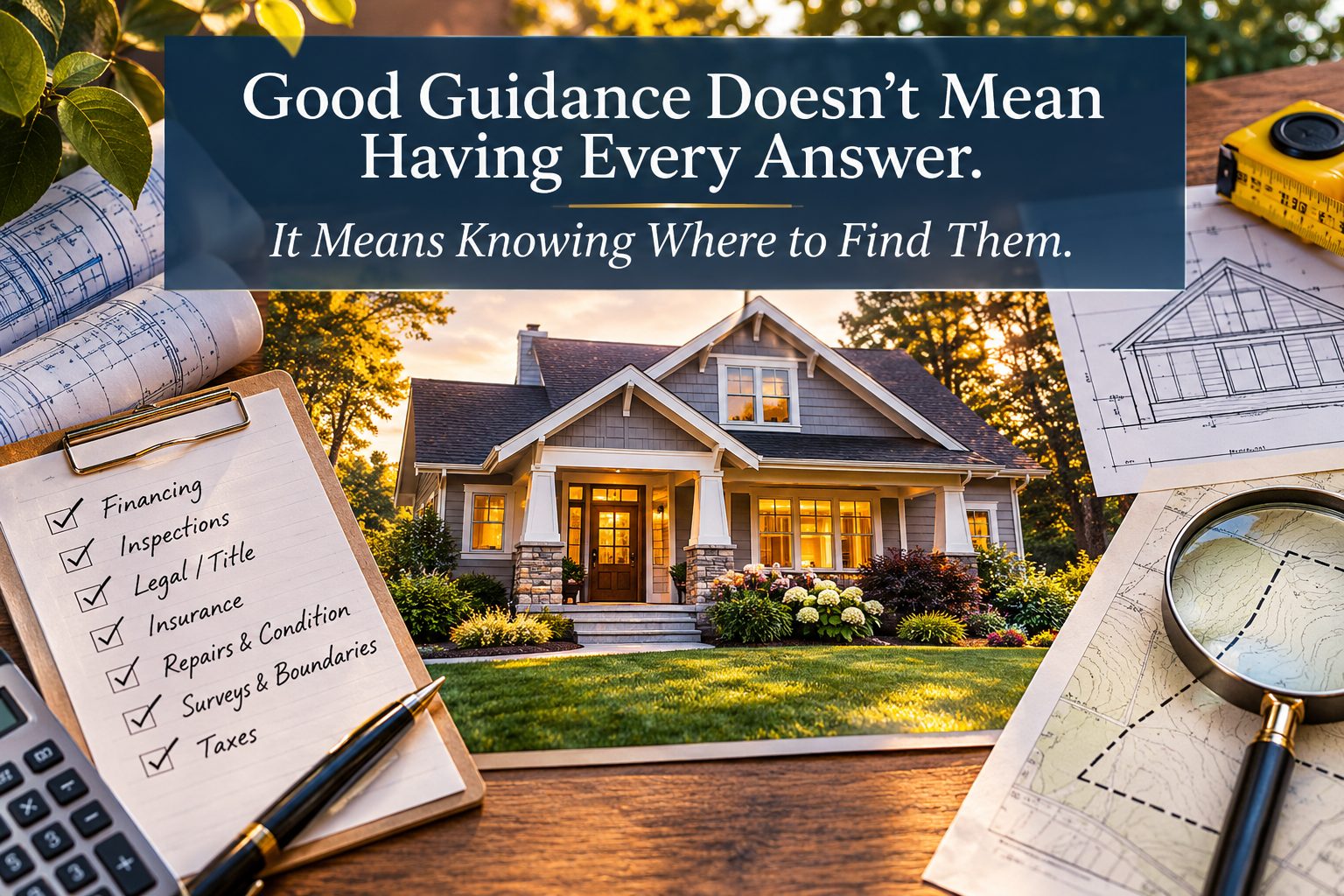
One of the most valuable things I’ve developed throughout my real estate career is an understanding of not only what I know, but also what I need to know, where to find that information, and who to turn to when additional expertise is needed.
Real estate is a remarkably multifaceted profession. Every transaction brings its own set of circumstances, and with those circumstances come questions that may extend well beyond the scope of real estate expertise.
Over the years, I’ve developed relationships with professionals across a variety of industries. The value of those relationships isn’t simply having someone to call. It’s understanding what those professionals bring to the conversation, when their expertise may be beneficial, and how their knowledge can help my clients make more informed decisions.
I often talk about education and information as the foundation of my approach to real estate. Part of that philosophy is recognizing that I don’t have to be the source of every piece of information to be instrumental in helping my clients obtain it.
Knowing when to stay in my lane, when to bring another professional into the conversation, and how to help my clients navigate the information they receive are all important aspects of how I serve them.
Knowing What You Know — and What You Don’t
Experience in real estate teaches you a great deal.
Over the years, I’ve worked through property inspections, appraisal concerns, financing complications, title questions, unexpected repairs, and countless situations that required careful evaluation and creative problem-solving.
That experience helps me recognize potential concerns, anticipate questions, and understand when additional information might be necessary.
But experience doesn’t make me a structural engineer, home inspector, attorney, lender, tax advisor, or insurance professional.
And it shouldn’t.
My responsibility is to provide knowledgeable real estate guidance while recognizing when a situation calls for specialized expertise.
For example, if a home inspection identifies a potential structural concern, I can help my client understand how that concern might affect their real estate decisions. I can discuss contractual considerations, available options, timelines, and possible negotiation strategies.
What I cannot responsibly do is independently determine the structural integrity of the home.
That’s where the appropriate specialist comes in.
Knowing when to involve that specialist isn’t a weakness in my representation. It’s part of how I approach protecting my clients’ interests.
This philosophy also aligns with the National Association of REALTORS® Code of Ethics, which emphasizes professional competence and the importance of involving qualified expertise when appropriate.
A Referral Should Be More Than a Name on a List
Relationships matter in real estate, but not simply because it’s helpful to know people.
What matters is understanding what those professionals do, how they communicate, what kinds of situations they’re equipped to handle, and whether their approach might be a good fit for a particular client’s needs.
When I recommend a professional, I want that recommendation to mean something.
I don’t believe there’s a magic number of referrals that makes a recommendation more responsible or valuable.
Sometimes I may have several professionals to suggest. Other times, I may know one person whose experience is particularly relevant to the situation.
The number isn’t the point.
The reason behind the recommendation is what matters.
I want to feel confident that someone I’m recommending has the knowledge, professionalism, and commitment to service that I would want for my own clients.
That doesn’t mean I can guarantee another professional’s work, pricing, availability, or results. I can’t, and I wouldn’t suggest otherwise.
It also doesn’t mean my recommendation is the only option.
Clients are always free to investigate other providers, compare qualifications and costs, ask questions, and choose whomever they feel is best suited to their needs.
In fact, I encourage that independence.
A recommendation should be a useful starting point for making an informed decision, not a substitute for making one.
When Professionals Disagree, There’s Often More to Learn
One of the most valuable things a client can do is listen to different professional perspectives.
Consider a situation where a home inspection identifies a concern with a property’s roof.
The inspector may recommend further evaluation based on visible conditions. A roofing contractor may assess whether repairs are practical or replacement is advisable. An insurance professional may identify coverage considerations. A lender may have requirements related to the property’s condition.
Those professionals aren’t necessarily answering the same question.
And their conclusions may differ.
Rather than assuming one perspective automatically overrides the others, I encourage my clients to understand what each professional is evaluating and why.
What information supports their conclusions? Are there limitations to their assessments? What risks, costs, or alternatives should be considered? Is additional evaluation warranted?
Sometimes the best next step is to ask more questions.
Sometimes it’s to obtain another professional opinion.
And sometimes it’s to recognize that more than one reasonable path forward exists.
My job isn’t to decide which answer my client should accept. It’s to help them understand the information, evaluate the implications, and make the decision that best aligns with their goals and comfort level.
That’s where education becomes especially important.
Good Communication Is Part of Good Representation
Even when everyone involved has the best intentions, real estate transactions can become complicated.
Different professionals have different responsibilities, schedules, communication styles, and priorities.
And sometimes communication simply doesn’t happen as effectively as it should.
I can’t control that.
What I can control is how I respond.
I can follow up. I can ask for clarification. I can help identify what information is missing. I can communicate relevant developments, work to keep conversations productive, and make sure my clients understand what is happening.
I can also recognize when a matter requires a conversation directly between my client and another professional rather than trying to interpret or answer questions outside my expertise.
This extends to my interactions with other real estate agents, too. We may approach situations differently, disagree on a negotiation strategy, or encounter communication challenges.
But I remain responsible for my own professionalism and follow-through.
I don’t need everyone involved in a transaction to work exactly as I do.
I need to be accountable for how I work.
The Right Resource Depends on the Situation
There is no universal list of professionals that every buyer or seller will need.
A first-time buyer evaluating financing options may benefit from detailed conversations with mortgage lenders or mortgage brokers.
Someone purchasing an older home may need additional insight into electrical systems, foundations, roofing, or environmental concerns.
A seller preparing an inherited property for sale may need guidance from an attorney or tax professional about matters beyond the scope of a real estate transaction.
And a client considering vacant land may need a surveyor, soil professional, zoning official, or other specialist before deciding whether the property meets their intended use.
The appropriate resources depend on the property, the circumstances, and the questions that need answering.
For example, the Consumer Financial Protection Bureau offers guidance on comparing mortgage Loan Estimates, while the Environmental Protection Agency provides information about radon testing for homebuyers and sellers.
These resources can help clients become better informed, but they don’t replace individualized guidance from the appropriate licensed or qualified professional.
Part of my role is helping clients recognize which questions deserve further investigation and where they may find reliable information.
Not every concern requires a specialist. Not every question requires another opinion. And not every transaction needs the same resources.
The goal is to be thoughtful about what the circumstances actually warrant.
Information Should Support Your Decisions, Not Replace Them
I believe good real estate guidance should leave clients feeling more informed, not more dependent.
That means explaining options rather than simply issuing instructions.
It means acknowledging uncertainty when it exists.
It means recognizing that two people can receive the same information and reasonably make different decisions because their priorities, finances, tolerance for risk, and long-term goals are different.
A buyer may be comfortable proceeding with a property after learning about a potential repair. Another buyer may decide that the same concern exceeds their comfort level.
Neither decision is automatically wrong.
What matters is that each person understands the available information, the potential implications, and the choices in front of them.
I can offer perspective based on my experience. I can explain real estate considerations, help evaluate options, and recommend additional resources when appropriate.
But the decision belongs to the client.
And the pace they’re comfortable with is the pace we move at, within the realities of any applicable contractual deadlines.
Relationships Are Valuable Because People Are
At the heart of all this is something I learned long before I became a Realtor®: service is about people.
Relationships with knowledgeable professionals are valuable because they create opportunities to exchange information, solve problems, and help people navigate unfamiliar situations.
But those relationships are not the goal in themselves.
The goal is taking care of the person who has trusted me to guide them through an important decision.
That requires experience, preparation, communication, judgment, and sometimes the willingness to say, “This is a question we should ask someone with more specialized expertise.”
I don’t believe being a good Realtor® means having every answer.
I believe it means knowing which questions to ask, understanding when additional expertise is appropriate, and helping clients access the information and resources they need.
And throughout that process, I remain accountable for the part I can control: how I work.
Your goals. Strategic guidance. Confident decisions.
That’s more than a tagline. It’s the philosophy behind how I approach my work with buyers and sellers throughout Virginia and West Virginia.
Frequently Asked Questions
Should my Realtor® recommend inspectors, lenders, or other service providers?
A Realtor® can be a valuable resource for identifying professionals who may be appropriate for a particular situation. Recommendations should be considered alongside your own research into qualifications, experience, pricing, availability, and compatibility with your needs. You remain free to select your own service providers.
Does a Realtor® guarantee the work of a professional they recommend?
No. A recommendation is not a guarantee of another professional’s services, costs, timelines, or results. Clients should independently evaluate providers and understand the terms of any services they choose to obtain.
What if my home inspector and a contractor disagree?
Different professionals may evaluate different aspects of a concern or reach different conclusions based on their expertise and the information available. Ask each professional to explain their findings, the scope and limitations of their evaluation, and the reasoning behind their recommendations. Additional specialist opinions may help you decide how to proceed.
Can my Realtor® provide legal, tax, or mortgage advice?
A Realtor® can explain real estate transaction processes, contractual considerations within their professional role, and general financing concepts. However, specialized legal, tax, lending, and other professional advice should come from appropriately qualified professionals.
How do I know whether I need another professional opinion before buying a home?
Consider the significance of the issue, the qualifications of the person who identified it, the potential financial or safety implications, and whether important questions remain unanswered. Your Realtor® can help you understand relevant transaction deadlines and options while you consult appropriate specialists.
Why do professional relationships matter in a real estate transaction?
Strong professional relationships can help facilitate communication, access to relevant expertise, and coordination when challenges arise. Their greatest value is not simply who knows whom, but how effectively those relationships can support informed decisions and the client’s individual needs.
Nicole Lewis, Realtor® | Coldwell Banker Premier
Serving buyers and sellers throughout the Northern Shenandoah Valley of Virginia and the Eastern Panhandle of West Virginia.
Your Goals. Strategic Guidance. Confident Decisions.